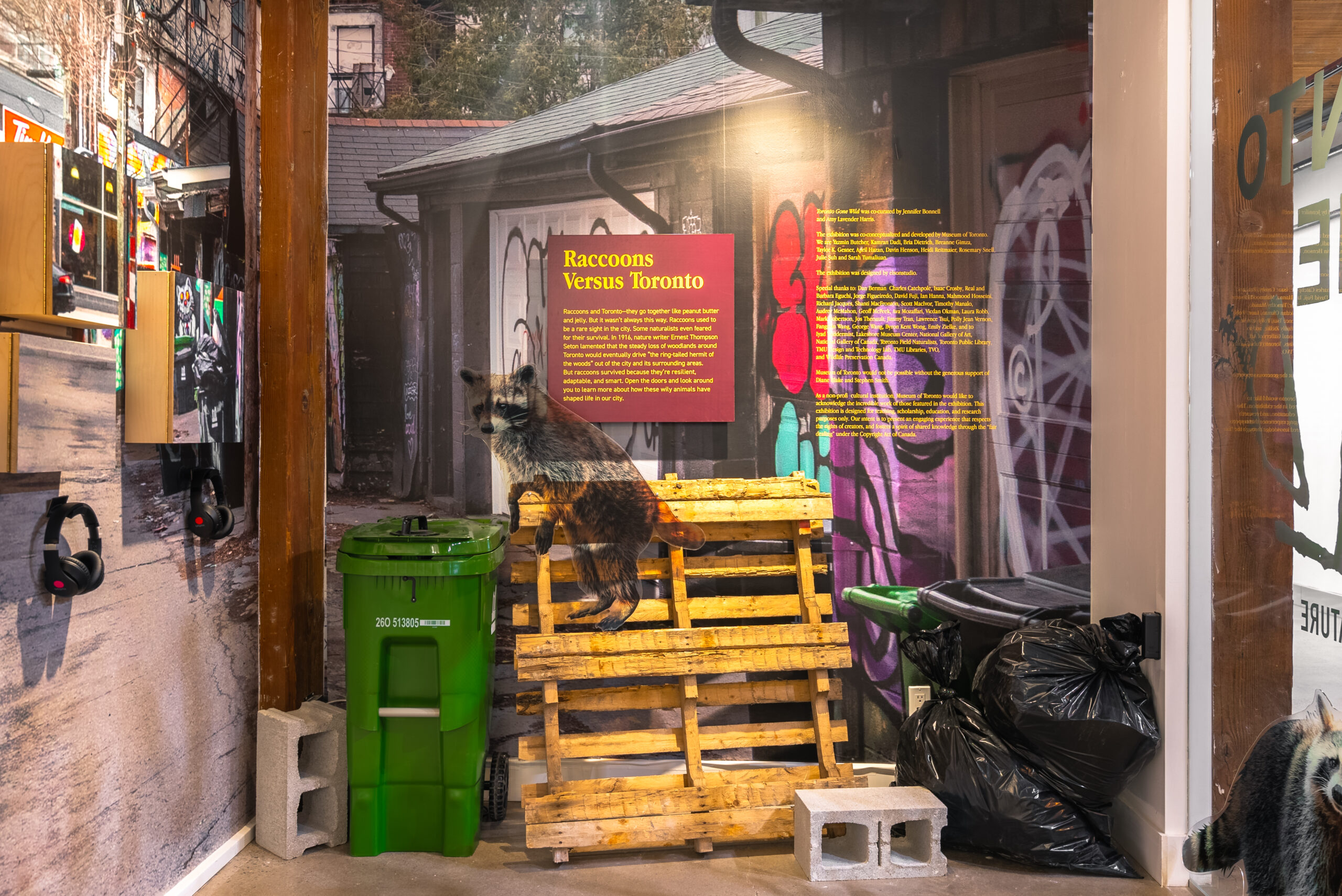
Raccoons and Toronto—they go together like peanut butter and jelly. But it wasn’t always this way.
Raccoons used to be a rare sight in the city. Some naturalists even feared for their survival. In 1916, nature writer Ernest Thompson Seton lamented that the steady loss of woodlands around Toronto would eventually drive “the ring-tailed hermit of the woods” out of the city and its surrounding areas.
But raccoons survived because they’re resilient, adaptable, and smart. Open the doors and look around you to learn more about how these wily animals have shaped life in our city.
1920s-30s: Reclusive Wildlife
“Wild game haunting environs of Rosedale,” declared the Toronto Star in 1925, after a gardener caught a raccoon overturning a garbage pail. The intruder was such a curiosity that it ended up at the Toronto Zoo. In the early 1900s, Torontonians who reported a raccoon could expect quick action from city authorities, who usually returned the animals to the woods.
But raccoons were moving into city spaces for a reason: increasing urbanization had reduced forest habitats for wild animals. Bears and lynxes had retreated to more remote areas, and naturalists predicted raccoons would soon follow.
1950s-60s: New Neighbours
By the early 1950s, raccoons were a familiar sight across Toronto. Despite the shrinking woodlands, these animals survived—and thrived—by adapting to city life. They dined on the variety of food scraps that humans discarded, and settled into human-made structures, like attics, chimneys, sheds, and garages.
Of course, this led to property damage—and irate homeowners, who sought guidance from the Toronto Humane Society (THS). Bylaws prohibited residents from destroying the animals, and city officials quickly became overwhelmed with requests to trap and relocate nuisance raccoons. Ultimately, the city and THS reduced their efforts. Unless an animal was sick or injured, they wouldn’t intervene.
1976: East York Declares War
By the early 1970s, raccoons owned Toronto. Newspaper stories touted their brazen activity: a raccoon entered a church during services; others had to be evicted from Osgoode Hall.
In 1976, East York—still politically separate from Toronto—voted to destroy any raccoon trapped by homeowners, regardless of the animal’s behaviour or health. Not everyone supported it. When Howard Chandler, the councillor responsible for the motion, ran for mayor, he was defeated by Alan Redway, who promised to leave raccoons alone. Toronto abandoned similar plans for a raccoon round-up, but authorities continued to euthanize nuisance animals into the early 2000s.
1980s-90s: A Humane Solution
In the 1980s, provincial authorities estimated that Toronto had about 7-20 raccoons per square kilometre (km2), with areas of Scarborough topping out at 100 per km2. For raccoons, the move to the city had been a stunning success. But Toronto residents remained divided in their attitudes toward their furry fellow residents.
Enter Toronto wildlife biologist Brad Gates, who developed a passive removal technique for attics and sheds: block any entry point with wire mesh, and install a one-way door that lets raccoons out but stops their re-entry. Gates’ approach took off, and it remains the primary method for raccoon removal in Toronto.
2002: Our Urban Overlords?
Like humans, raccoons are inventive and opportunistic. When Toronto introduced its green bin program for organic wastes in 2002, raccoons quickly learned how to access this rich and reliable food source by knocking over the bins. Raccoon populations exploded, earning Toronto the nickname“raccoon capital of the world.”
Interactions with humans have changed raccoons. City raccoons are larger and feistier than their country relatives. They’re more dextrous, and easily scale fences and power lines. Scientists also suspect their brains have changed too—when we try to keep raccoons out of our trash bins and living spaces, they continue to strategize new ways of getting in. Despite Toronto’s attempts to control their numbers, raccoons have made it clear: like us, they’re here to stay.
Raccoon Nation (2011)
[insert clip here]
The Story of the Raccoon
Raccoons have a place in many First Nations stories. In a version of the Anishinaabe story, Esiban (Raccoon) pranks two elderly brothers, sparks an argument between them, and then steals their food. Angered by Esiban’s behaviour, Nanabush—the Anishinaabe hero and trickster—teaches him a lesson:
Nanabush decided the world would know of Raccoon’s misery. “I am going to take away half your eyesight, you will see but not very well, you will only be able to hunt at night, when you do find food, you will have to find water to wash it before you eat.”
Nanabush took some soot from the fire and rubbed it across Raccoon’s face. He took more and wiped it across Raccoon’s tail. “From now on, people will see your mask and know to be weary of you. The four stripes on your tail will remind you of the meat you took from the brothers.”
– as told by Ojibwe Knowledge Keeper Anishinaabe-Mindido (Big Man) Richard Jaques (Nanawin)