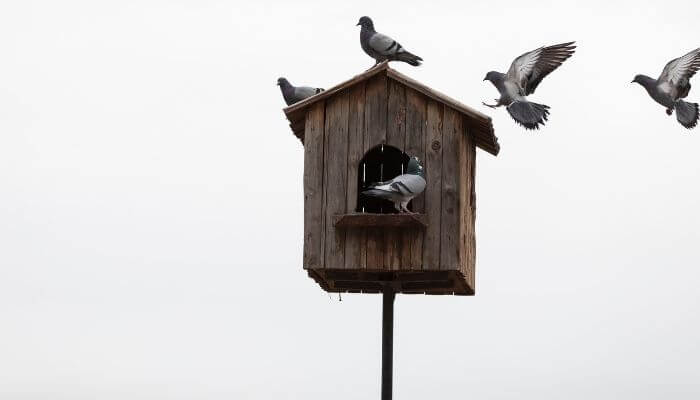
Pigeons have a deep history in this area. In fact, Mimico gets its name from the Anishinaabek word Omiimiikaa, which means “place of the wild pigeon.”
From eating habits to migration stories—and even a few recipes—both rock pigeons and passenger pigeons have surprising stories to tell. Look around you to explore these fascinating birds.
Once There Were Many…
For early European settlers, passenger pigeons were a marvel and a blessing. English artist and diarist Elizabeth Simcoe described the “flights of wild Pidgeons [sic]” that “darkened … the air” each spring and fall as they coursed up the Humber and Don river valleys in the 1790s. William King, a soldier at Fort Mississauga in what is now Niagara-on-the-Lake, reported witnessing a “grand migration” in May 1860. He estimated that the flock numbered in the millions of birds. Stretching a mile wide and 300 miles long, the flock took 14 hours to pass overhead. While it may seem like a tall tale to us now, King’s was one of many accounts like this.
Pigeon Years
In the spring, passenger pigeons made the journey north, travelling from the southern United States to nest and raise their young in the Great Lakes area. A typical pigeon roost would blanket hundreds of square kilometres of forest, destroying tree leaves and underbrush with their acidic droppings. These flocks often changed location, tying their movements to the availability of beechnuts, acorns, and other nuts and seeds—what biologists call mast. Some trees and shrubs produce a bumper crop of mast every seven or eight years, which attracts a lot of wildlife. For Indigenous communities and early European settlers, these “mast years” became “pigeon years” and meant a bountiful harvest of the birds.
Dinner is Served
Both Indigenous and settler communities celebrated the springtime arrival of pigeons with feasting and revelry. In what is now Toronto, the Huron-Wendat, the Seneca and later the Mississaugas boiled and stewed pigeons,or dried them in smoke to preserve for winter.
Settlers broiled, roasted, and stewed the pigeons, or salted them away in barrels to eat later. Most famously, they made pigeon pot pies. A good pot pie contained five or six pigeons with “three feet nicely cleaned” sticking out of the middle, “to show what pie it is.”
…and Then There Were None
By the late 1800s, European settlers had overhunted passenger pigeon populations—for food and sport—into near-extinction. Humans had reduced the billions of pigeons in the 1870s to mere dozens by the 1890s. At the same time, extensive logging had reduced their forest habitats and food sources. Humans reduced the billions of pigeons in the 1870s to mere dozens by the 1890s.
Dwindling numbers eventually reached a tipping point.Today, scientists understand that the enormous groups in which passenger pigeons lived were essential to their survival. The last known nesting colony in Ontario—a group of about twenty birds near Kingston in 1898—had vanished by 1900. The last passenger pigeon on earth, a captive bird named Martha, died at the Cincinnati Zoo in 1914.
The City Smarts of Today’s Pigeons
Rock pigeons—the birds we see in Toronto—are the descendants of wild European rock pigeons and domesticated carrier pigeons. Rock pigeons aren’t closely related to passenger pigeons.
Rock pigeons are highly adaptable and intelligent. Unlike passenger pigeons, who only fed on the fruits of oak, beech, and tamarack trees, rock pigeons are flexible feeders. They’ve adjusted their diets to include the variety of edible food scraps found on our city streets.
The Secret Life of Pigeons (CBC)
[insert video here]